Hello, I've stopped posting here and taken up posting at www.QuasiFarmer.com Please come follow me there.
Showing posts with label Fellowship. Show all posts

Friday, October 26, 2012

Driving through Jiangsu Province

Yesterday was a fast day.  On Tuesday night I got a frantic call from Peggy (our translator/chaperone) - there wasn't enough time to do everything we were scheduled to do the next day, and make our flight.  We spoke for a few minutes, and decided on visiting a teapot museum over the fisheries visit to Taihal Lake.  I want to make sure that I see some of the cultural things, and Dr. Hu (2011 Fellow) had strongly recommended this museum and it was on my official schedule.  Several minutes later she called back and said that the people at Taihal Lake REALLY wanted to see us and show us the lake, but that the museum was also very eager to see us.  After some further discussion we decided to shorted each visit by a little and see them all.

First stop of the day was to the Bocorra Teapot Museum.  I like tea.  I think traditional teapots are cool.  I know nothing about teapots and have never really gotten the chance to go to a place that has thousands of them on display.  Historical teapots, and representative works from some of the best potters in the world.  We almost ran through the building in order to visit it and get to our next stop, but we had our own guide who gave us a quick overview of the history and different styles of teapots in China.  here is a quick sampling -


Dr. Hu had arranged for them to give me a Bocorra teapot on his behalf, and it was a beautiful example of the current local work from the potters.

We then proceeded to Huaxi Village.  Governments here are set up on the following system - National, Provincial, County, Town, and finally Village.  Villages are the aspect that most Chinese, not living in a city, deal directly with.  They also own the property.  The Village is in charge of assigning each resident a plot of land to farm.  In some villages they have begun to consolidate farming operations into cooperatives (more a collective farm than what we would think of in the US as a co-op).  The village also often owns a store, and sometimes even factories, assigning residents to work in various capacities, fitting to their abilities, including in the schools, government offices, police, fire, etc . . .  People are free to leave the village and move, but in all cases the land they farm, and usually the home they live in is the property of the village, not theirs.  They therefore don't get to take it, or the value of it, with them. Huaxi Village is known as China's #1 village.  It is a village with 2,000 residents that, 40 years ago, looked just like most every other village in Jiangsu Province.  But today, thanks to the work of the secretary of the Village Communist Party Committee (think town mayor in the US) it has set itself apart.  In 1998 it became the first Commune to be listed on a stock exchange.  20% of all profits are paid as a distribution each year to each of the 2,000 residents.  Every adult resident is entitled to a luxury house, a car, free health care, free education . . . and free cooking oil.  The village has a massive steel factory, and food processing plant, and a hotel that is the 15th largest building in the world.  All together the combined assets of the village of 2,000 people (not the residents mind you) are almost half a billion US dollars.  But there is a downside.  It takes a lot of manpower to make the place work.  Residents are expected to work 7 days a week, with just a single day off "every now and then".  Picking a flower from the gardens (immaculate by the way) carries a fine of $1,500 USD.  And perhaps most jarring - everything (the houses, cars, furniture - everything) is owned by the village   leave the village and you leave it all behind.


From there we went on to the Fisheries and Ocean Department for Jiangsu Province, to their Tai Lake facility.  At 900 sq miles, it is the third largest lake in China. The staggering thing however is the depth - 13 feet at its deepest, and 6 feet on average.  It is the water source (non potable) for over 30 million people, and is a major tool in flood prevention, and food production.  It also suffers from some major pollution issues, but serious efforts have been made to cut back on the nutrient loading, and they are making some good headway.


We hopped back in the car and headed south to the city of Wuxi and arrived at about 6:00.  All told we spent about 7 and a half hours in the car and saw a great deal of the countryside.


Monday, October 22, 2012

Our last days in Mongolia.

I've been a little lax lately in my posting.  I apologize, but sometimes it seems with all the things we are actually doing, its difficult to sit down and write about them.  When last I left off we had just two days left in Mongolia.

Wednesday (the 17th, yes almost 6 days ago) was a day to see some farms.  After a brief meeting with the Executive Director of the Mongolian Wool and Cashmere association, we climbed into Mr. Tuvshin's truck, and we headed north.  we drove about 90 km out of UB and pulled into the center of a small town, and up to the municipal buildings.  We were met by one of the Governor's deputies to be our local guide, and we headed north once again.  After a short drive our new guide pointed off to a set of buildings a few kilometers off the road to the road to our left, and as is the way in Mongolia, we just pulled off the road, and headed straight that way.  At times there was what resembles a dirt road, at other times, it was just driving through washes and across open ground.


We pulled up beside a concrete block wall and the four of us climbed out of the vehicle.  There were just two buildings within the walled area - a small house built in the american style, and a small to medium size barn.

I was on visiting a 60 cow dairy farm that in some ways looked like many back home, but in others was very different.  The family was just three years into the dairy business.  They got into it with no farming experience and little beyond internet research to work from.  They have a 5 year loan at 20% interest (pretty standard for Mongolian lending).  They also opened a yogurt factory in UB and all of their milk goes to the yogurt factory.  The farm has 4 employees, the yogurt plant 6.  They milk the local breed of milk cow which yields roughly 1-3 liters of milk per milking, twice a day.  Feed is 100% pasture, and the cows only come into the barn to be milked each day from April-November, but November-April they come inside at night as well.

Perhaps one of the most impressive thing was the home made methane digestor.  There is a pit in one corner of the barn where the manure is pushed.  It is mixed with hot water, and pumped into a tank where it digests for up to 3 weeks.  The bio gas produced provides 100% of the barn's power needs and heating needs.   It was simple, practical, and 100% made by them.  We talked about some of the improvements that they want to make such as alley scrapers, a yard for the cows, and the largest - growing their own feed.  They had purchased 26 Holstein embryos from France, and frozen semen from China.  They now, among their herd of Mongolian cows, have 24 Holstein calves which they hope will improve their milk production dramatically.  They tried raising corn this year, but like a few other farmers I met, the crop failed.  They buy seed from China, and I suspect it is just not suited to the incredibly short growing season.  Add on top of that the complete lack of fertilizer that is used and the crops simply don't grow.  I promised to do some research and see if any of my contacts in the states knew of international suppliers of short season silage corn.  That's a project for my return.

We next visited with the largest dairy farm in the aimag (province).  Mr. Tsogtbuyan worked on a large state run dairy farm for roughly 10 years before the fall of communism.  At that time state run farms, including the one he worked on, collapsed   The knowledge, operating capital and most of the connections for supplies returned to Russia.  He worked at various endeavors for several years, mostly trading between Russia, Mongolia, and China.  He saved his money and soon leased some land, and began a small farm, including a small dairy operation.  Over the last 15 years it has grown to 260 milking cows.  They too buy embryos from France and frozen semen from China.  They cut wheat, stalk and all and store it in an "in ground" silage bunker, fermenting it as we would corn silage.  Their attempts to grow corn have been just as successful as other farmers here I have met.  After the tour of his farm he invited me into his house to talk at length about his operation, his life, and farming in general.  We talked about crop insurance and government backed loans - two things that help stabilize agriculture in America.  He told me about some of the most basic challenges - while crop land can be leased, grazing land in Mongolia cannot.  Herders graze their land on anything that is unclaimed.  Or they are supposed to do it that way.  In reality they graze their animals where ever they please (even if that area happens to be an almost ripe wheat field, fences being no barrier to wire cutters.)  The herders practice natural breeding, the bull cattle, boar goats, and ram sheep all running in the herds, meaning that a farmer who takes great care to improve his herd is constantly at risk of his imported bloodlines being diluted by a nomadic herder's straying bull.  It was a touching and long conversation in which I learned a lot about the last 30 years of Mongolian agriculture and some of the challenges it currently faces.

When we returned to UB we had one last "official" event to do.  Ms. Batchimeg, a 2010 Eisenhower Fellow has been crucial to the success of my visit to Mongolia.  At the time it was first decided that I would be visiting Mongolia she was serving as the National Security Adviser to the President of Mongolia.  She graciously volunteered to oversee my visit, even going so far as to provide the services of her assistant to Eisenhower Fellowships.  We had met briefly at the Eisenhower Day of Fellowship, and we got to have a delightful dinner with her and Enke, her assistant who has been in charge of planning my days in Mongolia.  In the most recent elections here in Mongolia Ms. Batchimeg has joined two other Eisenhower Fellows in the Mongolian Parliament.  Not only that, but with an influx of new, young, successful Members of Parliament in the recent election, her party, the Democratic Party is now in power.   Dinner was a perfect capstone to our stay in Mongolia.  She and Enke are both insightful, optimistic, outgoing and smart women.

Thursday was our last day in Mongolia.  But reality kicked in, and I had a lot of work to get done.  Eisenhower Fellowship Foundation has provided me an amazing opportunity.  While I need to take full advantage of the physical opportunities given and see the country, I also need to be a good guest.  This means writing e-mails and notes to the people I met with, following up on some things I promised to look into, and doing some of this stuff.  So that meant that while Liz was having an amazing time holding eagles, seeing camels up close and visiting a really neat temple and monument to Genghis Khan, I was stuck in the room doing work.  She'll have to blog about the first part of Thursday, I missed it.  That evening Mr. Tuvhsin and Mr. Shagai (our driver and translator for the 8 days) took us out to a local restaurant pub.  The were celebrating Oktoberfest.   The beers were 1 liter each, so Liz and I just had one each.  And of course there was much toasting with the Vodka.  In Mongolia, like Russian, Vodka is not for sipping, it's for toasting.  These two gentleman made our experience what it was.  I spent most of each day with them, Liz almost as much.  They were hard working, courteous, went out of their way to make sure my trip was a success, and opened their minds and their hearts to us, sharing not only their country, but their honest thoughts and opinions on issues as diverse as the US election, Abba, religion, and more.

The next morning they both joined us to see off bright and early at the train station for our trip on the Trans-Siberian Railway.  But more on that in the next blog entry!

Thursday, October 18, 2012

Monday & Tuesday


Monday, the 15th of Oct.  After a restful Sunday evening, I returned to my schedule of meetings.  It started out fast with a high level meeting at the Government House.  It was intended to just be a short meeting - 9:30-10:00, but ended up lasting longer.  It was with a Mr. ERKHEMBAYAR  Lombo, the Urban and Rural Development Policy Advisor to the President of Mongolia.  I'll be honest, the meeting started out awkwardly.  We were met at the front door of Government House (the central building housing the parliamentary and executive branches of government here) by a young lady from the protocol office who whisked us, at a very fast pace down many hallways, up stairs, and down for what seemed like a half mile.  Finally we arrived at a massive set of double doors, and were ushered into a large room with very large, very formal chairs down each side of the room against the wall.  At the end of the room, were two more chairs, placed side by side, separated by a small table with a bowl of tiny candies.  I was directed to sit in one, and my translator (Mr. Shagai) sat in the first chair along the wall to my right.  After several minutes a staff person came in, whispered a few words to Mr Shagai and scurried out.  Mr Shagai let me know that he had been asked to translate for the meeting.  Several moments later Mr. ERKHEMBAYAR entered the room.  We shook hands and he sat at the chair to my left, facing the same way I was.  We proceeded to have at first a very formal conversation but it quickly loosened up a little.  It was still most awkward to sit in an over-sized chair with the person I am talking to on my left, facing the same way I am, with the translator sitting on my right.  All in all, it was a good conversation.  I learned a bit more about Mongolian animal husbandry.  For those of you who don't remember, one of the major reasons I came here was to learn how farmers here advocate.  How government interacts with the governed, in this case farmers.  I have gotten the sense in my time here however, and especially from Mr. ERKHEMBAYAR that frankly they don't seem to interact much at all.  There are analysts and researchers and academicians and politicians all talking to each other to figure out what is best for farmers.  There are farmers who are talking to each other about the fact that government should do something . . . but there is little exchange between the two.

From there I went to visit with Ms. TUUL from CHF International here in Mongolia.  CHF works around the world doing development work.  They have a project going on currently in both Rwanda and Mongolia to try and build capacity among dairy farms. I mentioned in a previous blog about how animal agriculture here works, and it holds true for most of the dairy farms in Mongolia as well.  The cows they milk are meat breeds and feed virtually 100% on pasture.  The average cow yields just 2-6 liters of milk a day, and is dry for 4-6 months of the year.  CHF is working to increase the capacity of the dairy farms by assisting with knowledge development in areas around raising feed, artificial insemination, herd improvement, etc.  The only feed that they have been able to raise successfully so far is wheat, the same wheat that most of the crop fields produce for milling into flour.  Attempts to grow corn as a feed have floundered, I suspect because of the incredibly short growing season and a lack of fertilizer used in crop farming here.

Tuesday, October 16th
Tuesday started with meetings at the Agricultural University here in UB.  For a country of 3 million  people, I was impressed with the size - over 10,000 students attend the university, specializing in animal husbandry or crop farming fields.

The crop farming centers primarily around wheat farming.  Some quick facts - whatever variety of wheat you grow here, it must have a growing time of 90 days or less.  It must be a summer grain due to a lack of snow cover and -40 weather in the winter.  It must be able to grow with .5-1.5 inches of rain a month during that growing season.  But they do farm a lot of grain (roughly 1 million acres of it) and achieve yields in the neighborhood of 1250 lbs/acre.  Land is cheap here and plentiful.  I mean really cheap and really plentiful.  All land is leased from the government, on a 30, 40, 60, or 100 year basis at a rate of 70,000 MNT/100 hectares, or about $.21 a year per acre.  Just prior to the fall of communism, there was more than 2 million acres of cropland being farmed.  After the fall, virtually every farm shut down and in the early 90's only a few hundred thousand acres were farmed.  that is slowly coming back, but there is land for wherever wishes to farm it at rock bottom prices.  That being said, there is no ready supply of anything to grow crops.  Everything must be imported from Russia, China, or further.

Cashmere in its cleaned,
but still raw state.
Animal Husbandry is also open for a seemingly limitless expansion.  Mongolians have over 50 million units of livestock in a country of 3 million people.  The breeds they raise are some of the hardiest on the planet.  They eat only grass, drink only what little snow they can find for 5 months of the year, and eat immense quantities of grass all summer.  Quality is now the buzzword.  Breeds are being improved, vaccinations are becoming commonplace, and some farmers are attempting to transition to growing some feed to supplement the nomadic/grazing farming style.  A new breed of cashmere goat that was created at the University produces on average 400 grams of high quality (15 micron) fiber each year, this compared to an average for the country of 100 or so grams of 17-18 micron fiber.

It is then dehaired, and
properly aligned.
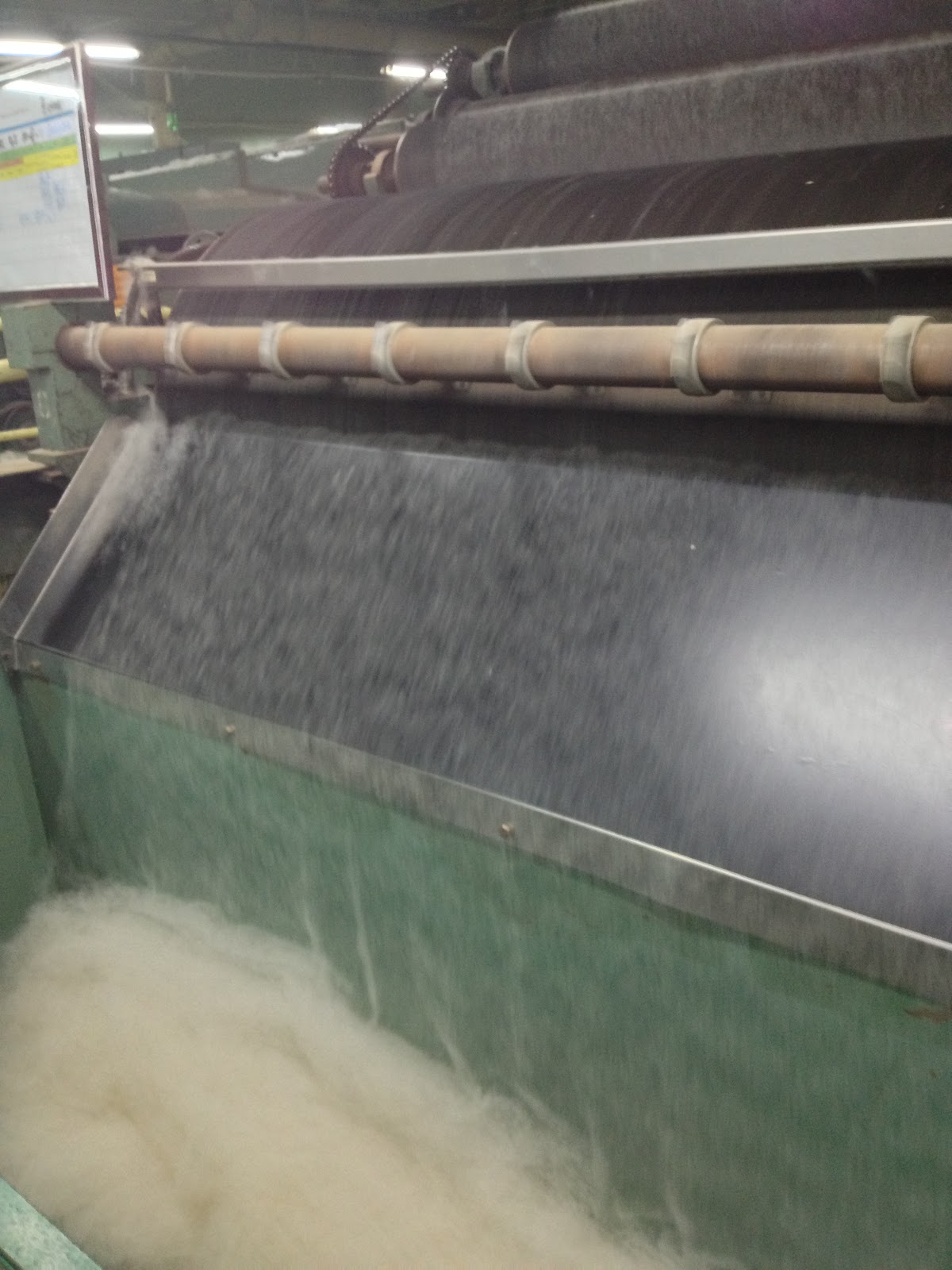
We then got visit a cashmere factory. As you may remember, we had visited the Gobi Factory Store earlier in the stay, now it was time to see the factory itself.  Mongolia is the second largest producer of cashmere in the world.  It produces on average 3,000 tons of the raw material each year.  It is the fastest growing part of animal husbandry in the country, and the factory we were about to visit is the largest factory of its kind in Mongolia.  It was first built under communism with Japanese investment, and has since been privatized.  It is 40% Mongolian owned, and 60% Japanese owned.

it is then pulled into yarn


It is laid down in flat continuous sections,
folded from side to side as it goes.


and spun.  there were 8 rows of yarn spinners
just like this one. The equipment was all very
advanced and from Italy.

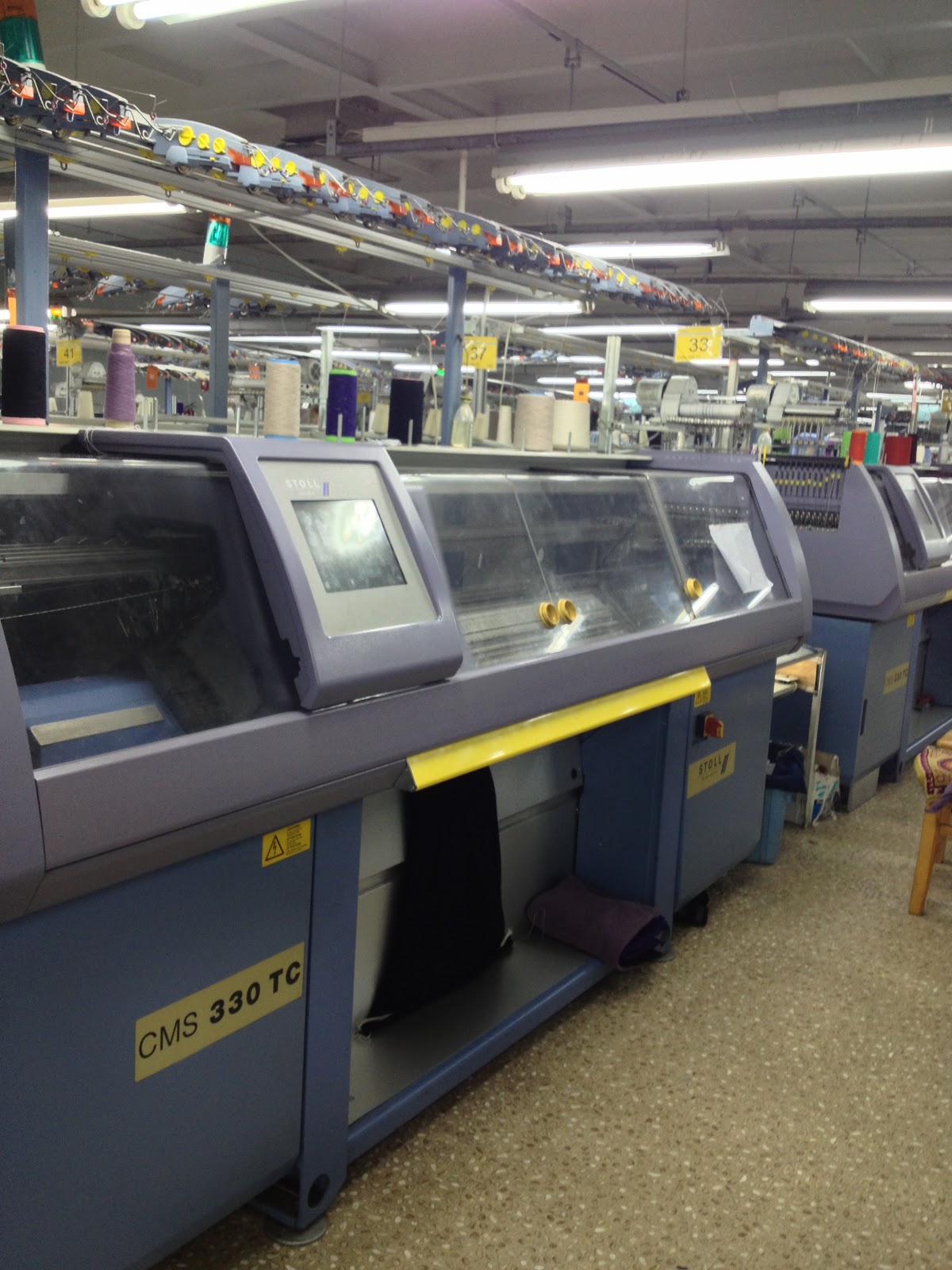
Row upon row of knitting machines were
then programed to knit a particular piece of a
garmet - a sweater body, a sleave, a blanket,
whatever, each machine knitting away.
Women sitting at various types of very advanced sewing
machines then stitched the pieces together, and sewed on
the labels by hand.
Despite each article being made one at a time,
there were boxes and boxes of each product.
The factory was impressive, and afterwards, we made one more visit to the cashmere store.  I succumbed this time and purchased a sweater.  The quality of the products where amazing, and I can honesty say, if you want high end, amazing quality cashmere, seek out Gobi brand, it is among the finest in the world, and produced in a very good factory with many very happy, workers employing local Mongolians.

We next got to visit a folk and ethnic cultural performance.  It was a show put on for the tourists like many you would seek in most regions of the world with unique cultures of their own.  It was about 1 hour and 15 minutes of some very impressive dance, throat signing, and a contortionist.

I'll leave you with two clips from the night.  Be sure to watch them both.  They are truly amazing.  I can't seem to get them to upload here to blogger, so you'll have to settle for clicking on a link to them on facebook - the contortionist; and the throat singer.


Tuesday, October 16, 2012

Sunday, Eisenhower Day of Fellowship

The Agenda was light for Sunday.  We had a luncheon scheduled for noon, and nothing else.  We hadn't had a chance to do much in the way of shopping for souvenirs or anything since we arrived, so Mr. T and Mr. S offered to take us to a cashmere shop or two.  We met at 9:00 and went to our first destination, "Cashmere World."  It was closed.  We went on to the next place and it was closed as well.  Seems most of these stores have switched to their winter hours and open much later.  So we decided to do a little site seeing in UB.

Zaisan Memorial honoring Soviet troops killed
in support of Mongolia
We drove to the south side of the city and through many new apartment complexes that were either recently built, or being built.  We drove partway up a hill, got out the car, and walked the rest of the way up.  At the top was a monument to Russian soldiers.  At the start of the 1900's, Mongolia was a part of the Qing Dynasty.  Following its fall in 1911 and the creation of the Republic of China, China still claimed Mongolia as  part of it's newly established country. Mongolia was struggling for independence, however there was little coordination in the local rebellions, and they were easily put down by Chinese troops.  Mongolia appealed to nations around the world - Russia, the United States, Japan, France and others to help it achieve independence.

As a result of the Belshevik Revolution in Russia, Baron Ungern, led his White Army troops into Mongolia in 1920 defeating the Chinese troops there.  With the Chinese occupying troops out of the way, and a White Army threat ensconced on its southern border, in 1921 Bolshevik Russia decided to support the establishment of a Communist Government and Army in an Independent Mongolia.  The combined Russian, and newly formed Mongolian Army removed the rest of the Chinese troops and the remaining White Army forces from Mongolia, and its Independence was declared on July 11th, 1921.

The monument has a large ring with a mural depicting the history of the relationship, starting with the Mongolian Revolution, and ending with the embrace of socialism.
The view from the top was striking, to see all of UB stretched out below.
The threat of Japanese Imperialism with the invasion of neighboring Manchurian in 1931 cemented the bonds between Russia and Mongolia even further.  During the Soviet-Japanese war of 1939 Russian troops successfully defended the Mongolian borders.  All of this is a long way of explaining the gratitude that Mongolians feel for the protection and support from the Russian troops.

One of the striking things we observed from atop the hill was the pollution.  The northern side of the city, known as the Ger District, is unlike the high-rises and Soviet Style housing blocks of downtown UB. It is a collection of roughly 5,000-50,000 sq ft fenced in yards with small houses.  In downtown UB the power plants are all combined heat and power plants and pump hot water/steam throughout the city.  Most every building in the downtown area is hooked up to this central heating system.  The plants all burn coal, but at least they are centralized, and thus reasonably efficient.  In the Ger District every home is heated with a coal stove.  Homes here have only been using this type of heat for about a week now, and you can see the resulting thick grey layer that has already settled over the northern part of the city.  Over the course of the next month it will slowly envelope the entire city in a gray sooty haze that will leave a black film on everything, and prevent people from seeing more than a few hundred kilometers in any one direction.  It will last for 5-6 months.

We left the monument and Liz got to do her Cashmere shopping as the stores had opened.  The Mongolian cashmere industry has been on the upswing for 30 years and it was evident from the quality of the products available.  But more on that later when I get to visit the largest cashmere factory in Mongolia.

We returned to the hotel and as we were pulling in, were witness to a moment in history.  As I had mentioned previously, we are staying in the first hotel ever built in Mongolia.  It was built by the Communist ruler, Tesdenbal in 1961.  Here on Peace Avenue, the Government House is at the center, one building from that was the Communist Party Headquarters, and adjacent to that is our hotel.  In 1954 a 14 foot tall Bronze statute of Lenin was erected atop an equally tall plinth outside the hotel.  It stood there, a central symbol of Mongolia's communism since that time.  In 1990 Mongolia did away with a single party system.  Since that time, while there have been other parties, the new Republican Party which was a change in name only from the former communist party still held control.  In elections this year, the Democratic Party won control of both the Parliament and the Presidency in the wake of a massive corruption scandal that landed the former Republican Party President in jail.  On Sunday Mongolia took down the last remaining bronze statute of Lenin (the statutes of Stalin had already been removed) on public property in the city.
Byambasuren Byamba-Ochir/AFP/GettyImages


We missed the actual removal as we were already close to being late for our Eisenhower Day of Fellowship event.  I have borrowed an image off the web of the removal.  As we left the hotel for the event, a strap was around the statute of the founder of the first constitutionally socialist state and he was being chiseled off his base.

Every year many Eisenhower Fellows from around the world gather in their home country on or around this date to celebrate a day of fellowship.  A day to come together and talk of our common goals, to network, and simply enjoy the friendship of each other.  I had the pleasure to celebrate my first such day here in Mongolia among an amazing group of mostly women fellows from Mongolia.  we were joined by recently appointed US Ambassador to Mongolia, Piper Campbell, and USAID Mission Director Francis Donovan.  I draw attention to the fact that the fellows were mostly women intentionally.  As a side note  I have been struck by the incredible number of women in positions of power here - it is a heartening thing to see and it might be by chance, but the vast majority of the leaders I have met with in Mongolia have been women.

It was a relaxing luncheon in an amazing venue.  As it was described to us, in the 1940's and 1950's "Ulaanbaatar was a shack. [Marshal Choibalsan] wanted to build a place he could welcome foreign dignitaries."  And he did.  This building, while not sprawling in size, was regal, beautiful and elegant.  It's ceiling murals and gold gilded fixtures would rival anything of the time in Washington, Paris, or London.  For almost 10 years Choibalson charted the course of Communist Mongolia from what is now known as the Marshal Palace.  It is in that place that we celebrated our Fellowship and leadership interests in the name of President Eisenhower.
From left to right:  Naranstetseg Unenburen (2001 Fellow and Director of Khaan Bank’s Retail Bank West), Bolormaa Tumendemberel (2001 Fellow and President of Mongolian Public Health Professionals’ Association ), Khulan Khashbat (2001Fellow and Governance Consultant/Lawyer), Ambassador Piper A. W. Campbell, Batchimeg Migeddorj (2010 Fellow and Member of the State Great Khural of Mongolia, ), Nathan L’Etoile (2012 Fellow), Elizabeth L’Etoile, Oyun Sanjaasuren (2001 Fellow and Member of the State Great Khural of Mongolia and Minister of Nature, Environment, and Green Development), Charles Montgomery (US Embassy Staff), Ariunaa Tserenpil (2006 Fellow and Executive Director of Mongolia’s Art’s Council) , Khashchuluun Chuluundorj (2007 Fellow and Professor at the School of Economics of National University of Mongolia), Francis A. Donovan (USAID Mission Director)


Sunday, October 14, 2012

Our tourist day

Well, It's the next day, and I want to try and get a little more caught up on the updates.  Saturday was a tourist day for us.  No meetings, just some great sightseeing.  We woke at our hotel in Suhbaatar around 7:30 having slept in and taken our time getting ready.  After breakfast with Mr. T. and Mr. S., we went outside and just admired the view for a short while.

See the red line?  That's "The" red line.  Liz is
one foot in Russia, one in Mongolia.
We were joined for a few minutes by Ms SUVDAA, the Governor's Chief of Staff, again and one of her staff.  She apologized that she had intended to join us for the morning's tour of the province but was called away to some election meetings.  We would be joined by her staff person to make sure we were comfortable.  We climbed back in the vehicle and began our journey to the Northeast towards Altanbulag on the Russian border.  On our way while driving past a large plain, it was shared with us, that on this plain is where a man named Genghis Khan won his first battle to unite the Mongols, feeling that united they could be an sizable force in the world.  Well, he was right, after that battle, and many years of warfare, he created the largest empire the world had ever known..


We continued on our drive northeast and pulled into Altanbulag, winding our way through the streets past parked cars and people walking to the border, we pulled up to the first gate and parked our car.  As we got out, we were escorted past the first checkpoint and into the border station.  We were met there by another border guard who took us around the rest of the checkpoints and up to the border itself.  We joked a little about the ease of "getting into Russia" but just 25 or so years ago, this would have been truly impossible, and the it would have been crawling with border guards.  As it was, there were many, and there were still strong double fences, and many guard towers.


We took a picture back on the Mongolian side, from left to right, that's Mr. TUVSHIN, Liz, Nate, and Mr SAGAI.  We climbed back into the car, and headed west this time, back through Suhbaatar, around the city, and then we headed north along a dirt, snow covered road.  Today was all about us just being tourists, and the scenery was amazing.  Frankly much of the drive there, when there weren't any buildings around, reminded me of the Berkshires after a snowstorm in December.  We kept heading steadily up, and steadily north until we arrived at a tiny little spot to pull off, with steps headed up the side of the mountain (which we seemed, over the course of the last hour to have already ascended much of.)  We got out and starting trekking through the snow, to the top.  When we reached the top, there was a small picnic area and some walkways out onto the most prominent outcroppings.  It was spectacular.

The Selenge River in the foreground, the mountains of Russian in the distance.

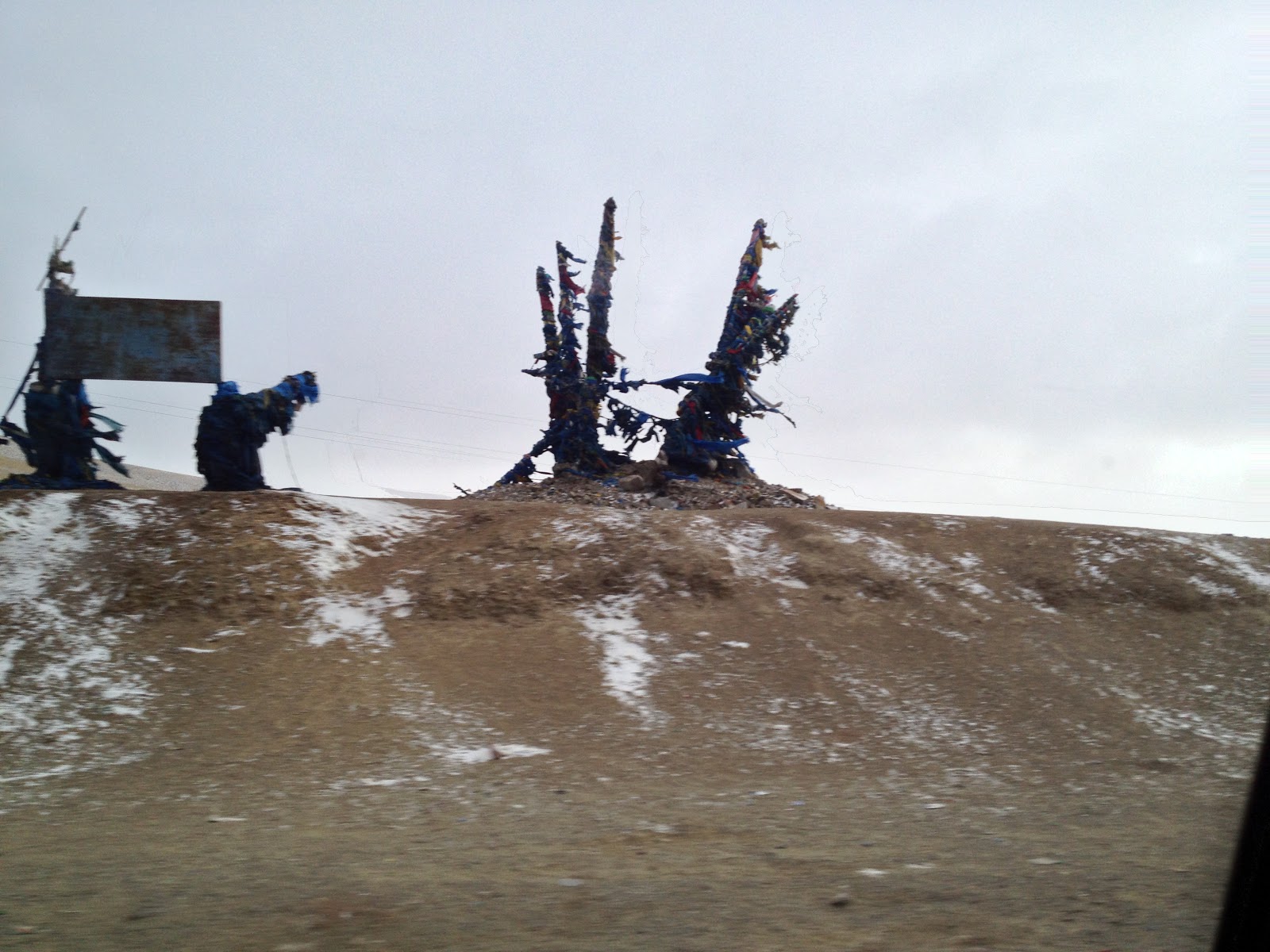
We then headed back to UB with a few short stops on the way.  We stopped at a Sacred Tree, which is a holy site in the Buddhist religion.  Pilgrims and passerbys alike come to the tree to make an offering, wishes and prayers.


The number of blue silk ribbons were staggering,
each one representing a wish or prayer.

The "wall" around the outer edge is made of packages
of tobacco left in offering.


The trees around the outside were also covered in ribbons as well illustrating the magnitude of people who had ventured well off the paved road, across a long, very rough dirt road to come to this place.

We hopped back in the car and settled in for our long ride back to UB.  a few hours into the trip we spied several combines harvesting a field of grain.  We pulled over, got out and took some pictures, and stopped to talk with the farmer for a few minutes.  In this field of wheat there were two Chinese combines working, both rented by the farmer.  The yields, the best I can work out with my unit conversions, are around 1250 lbs/acre.

Right next to the wheat field was a field of sunflowers being harvested with an old Russian combine, take a look at my facebook page to see the video of that machine in action.


This was a great day, and a great capstone to our trip north.  We slept very in preparation for our Luncheon the next day, joining with the Mongolian Fellows, US Ambassador Piper Campbell and some of her staff for the Eisenhower Day of Fellowship.  But more on that next time.

Selenge Aimag, a trip of opposites

When last I posted, we had only been in Mongolia for a day, and we were soon to depart for a trip north.  We didn't know what we in for, just that the itinerary said three things about the trip: that we were going to "Tour a Crop Field"; "Visit With Traditional Nomadic Family"; and that we were going 350 km north, to Suhbaatar, and then another 90 km on dirt roads.  Seemed like it would be a very long day, but an interesting one.  It was.

We had met our driver, Mr. Tuvshin and our translator Mr. Shagai the day before, briefly.  Turns out we had to get into one car for our ride outside of town, and then transfer to another once we reached the outskirts.  To reduce traffic, only certain cars are allowed on the roads of UB on certain days.  The SUV we were to take wasn't allowed on the streets that day, so they had to drive it out of the city the day before.

We headed out in the car for another mad drive through UB traffic.  Trust me when I say this, no matter where you have driven, there is no place that will prepare you for driving (or in our case even riding) in UB traffic.  We began to get to know Mr. T and Mr S. better as we traveled north.  Liz and I were busy snapping pictures while we talked.  Now think in your head of a poorly paved road near you.  Add some more potholes, make it straighter, and add huge washouts at various places - like swallow a smartcar type potholes/washouts.  Now sit in the back seat of the car as it does anywhere from 55-95 mph (yes, mph, not kph) down the road.  But the scenery was amazing.

The native herder's Gers.  They are the traditional nomadic herders,
and make up roughly 1/2 of the country's population.

Much of the view on the way north

At many places along the way there were Buddhist Religious Shrines.
Now throw in some goats and cows, even a few camels stepping out into the road at random times . . .

These were happily crazing on the side of the road.
Others had no issues just stepping into the road though.

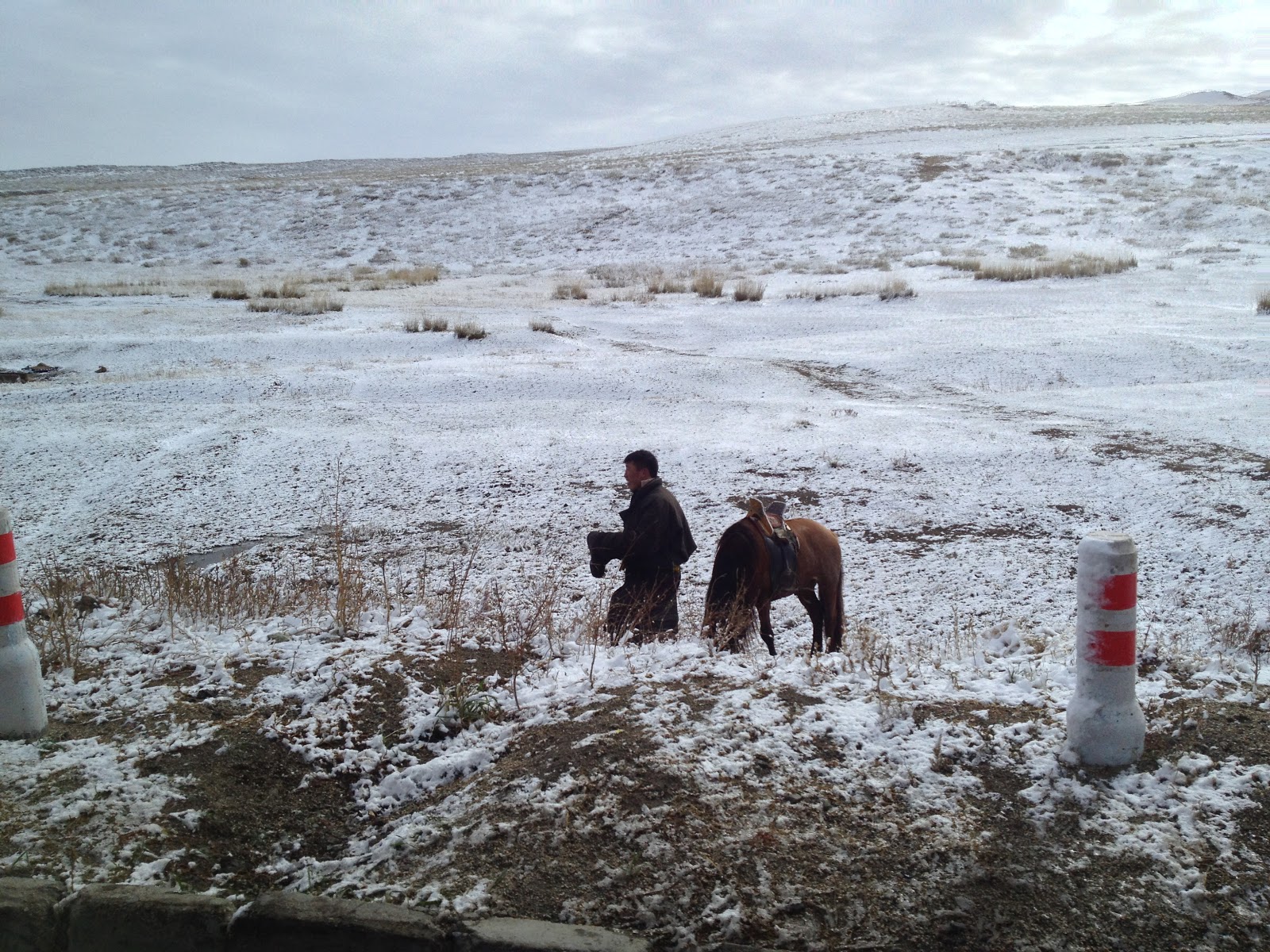
Most of the animals were tended by herders,
either on horseback, foot or motorbike.
We finally arrived in Suhbaatar, and arrived at our hotel to eat a quick lunch.  I chose a very traditional meal - milk tea (water, milk, butter and salt) and a baked sheep's head.  It certainly was interesting, and while the sheeps head was tasty, the milk tea was just a little too salty for me.  We were joined at the lunch by the Director of Administration for the Governor's Office of Selenge Province.  He gave us a brief and informal overview of the Province (Aimag) over our lunch.  After that we headed over to the Government Center, and met the Governor's Chief of Staff, Ms. SUVDAA, for our official welcoming into the Province.  She gave us a more specific and formal background of the province - directly north of UB, it contains both a major road crossing into Russia, but The major rail crossing into Russia as well.  It produces 60% of all the grain produced in Mongolia, and a huge amount of the meat products as well.  It has some mining as well, in addition to being a prime tourist destination for hunting, and sightseeing.  Pretty advanced with good roads for Mongolia.

We were told this was "Russian Socialist" style housing.
In most every town we came to, outside of UB, this was the only
housing available, all built in the 1950's-1980's, most crumbling.
One of the things that struck me however was the housing.  I know I've said it before, but it has just such and incredible eastern European feel, circa late 1980's, early 1990's.


A coal fired grain dryer at Gatsuur

We got in the car for our first set of opposites of the day.  We traveled roughly 90km on bouncy dirt roads until we came to a large gate on the left side of the road.  We were met outside the gate, and the guard opened it.  We were entering the largest farm in the country, one of 6 owned by the Gatsuur company, a 100% owned Mongolian congolmerate with interests in gold mining, hotels, farming and more.  While the company farms 125,000 acres, this farm alone (as I mentioned the largest in all of Mongolia) was roughly 65,000 acres with half that planted to wheat, potatoes and other vegetables.  Roughly 15,000 acres are irrigated, and on the non cropland, they free-range 6,000 cattle, 5,000 sheep, and 300 horses.  The crop operation rivaled anything you would find in the US - computerized grain storage, movement and drying, all top of the line planters, tilling equipment and combines, all green, and all John Deeres.  When asked how many combines they used for the harvest the manager of the farm, a young women in what appeared to be her late 30's responded that while they have 30, they were only able to run 24 this harvest as they lacked good operators.  While I didn't catch the model,each combine was capable of harvesting about 170 acres a day.

We next moved on to the farm's animal husbandry side of the operation, starting with the farmer's slaughterhouse.  It employs roughly 20 people, and can slaughter up to 100 cows, or 200 sheep or goats in an 8 hour shift.  They process all their own animals on the farm, selling most as dry aged carcasses.  They have recently added a butchering facility that processes up to 50 tons meat in a day, and are soon to open a sausage processing facility.  It was truly impressive.  One of their major investments is an attempt to improve their herd.  Over the last two years they have imported (by plane) 167 cattle from France.

I want to take a short sideline here to talk about how they raise meat in Mongolia.  It is done on grazing lands without fences.  A herder tends the flock, and corrals the animals each night.  The herder lives in a ger and as the grazing land runs out, moves his home and his herd.  The animals are fed no grain, and May-October, graze for 100% of their food.  The herder has a winter grazing ground that is kept free from grazing all year, and when possible the herder cuts native grasses for hay and piles it behind and atop a rudimentary shelter of logs and dirt at the winter grazing site.  In mid-late October the farmer moves his herd to this area, usually in the shelter of a mountain.  The herd grazes for much of its food all winter on this winter grazing ground, and instead of being merely corraled in an open pen at night, is put into the covered shelter each night.  The animals diet is supplemented with some of the cut grass when the weather is the worst, but this is minimal.  From October-December the animals are slaughtered, while they still have summer fat.  Breeding is done naturally within the herd, the bulls, rams, or bucks always being in the herd.  Its a bit different than what we do in US that is for sure.
A small part of the 1,000 goats that the nomadic herding
family raised for cashmere.  The herder was very proud
that the herd produced, on average, roughly 400 grams of
cashmere per animal.

After finishing up our tour, we were invited back to the farm's cafeteria - the farm's 120 employees all live on the farm in a large hotel/apartment complex.  We were served a dinner of meatloaf, potatoes and rice (with only the rice not having been grown in the farm).  It was now just getting dark and we had one more stop to make.  We got back into the vehicle, drove back out the gate, crossed the dirt road, and took off across several kms of open pastures until we arrived at a ger (or as we call them in the US, a yurt.)


After a short introduction we went inside and proceeded to go through several rituals.  First we had to get the seating correct - me on the right, Liz on the left.  I then accepted a sniff of snuff (no, not any of the hard stuff just tobacco) and a bowl of milk wine.  They ferment milk, and then boil off the alcohol  capturing it through a distilling process.  Oddly enough while it had a dairy taste, it tasted more like sake than anything else.  Liz and I each were instructed ahead of time that while it was fine to politely refuse, or just sip subsequent offerings, the first bowl/cup must be fully consumed.  They were not small.  Next came the vodka (made in Mongolia from wheat, actually one of the best Liz and I had ever had) and the dinner.  And yes, this would be our second dinner by 8:00, after having lunch around 1:00.  The pictures here tell the story of the meal - an entire lamb that is layered in an aluminum container with alternating layers of meat and hot stones and some vegetables.

The ger was amazing.  While it was bitter cold (windy and well below freezing outside) it was toasty warm inside with only a small stove fueled with dung to provide the heat.  There was a car battery with a solar panel, single florescent bulb, and a tv.  Did I mention the small Direct TV style dish out front?  What Liz and I both found the most amazing was were the topic quickly steered - who did we like in the US election; what did we think of Mitt Romney; of President Obama; and when we got back, we were to tell everyone that all of Mongolia was supporting Barack Obama.  Here I was naively thinking I had escaped the campaign season back home, and yet the most fervent campaigning I have been subject to all year was in a ger on the plains of the Selenge river, by a group of nomadic herders who really cared about who our next president would be.

After some very heartfelt thanking, we climbed back in the vehicle for our trip back to the Suhbaatar and our beds.  The next day was all play, but just as amazing, but it is late and I must save that for my next post.  As a teaser - based on the connections in the governor's office we got to stand one foot in Russia, one in Mongolia and never even show our passports!